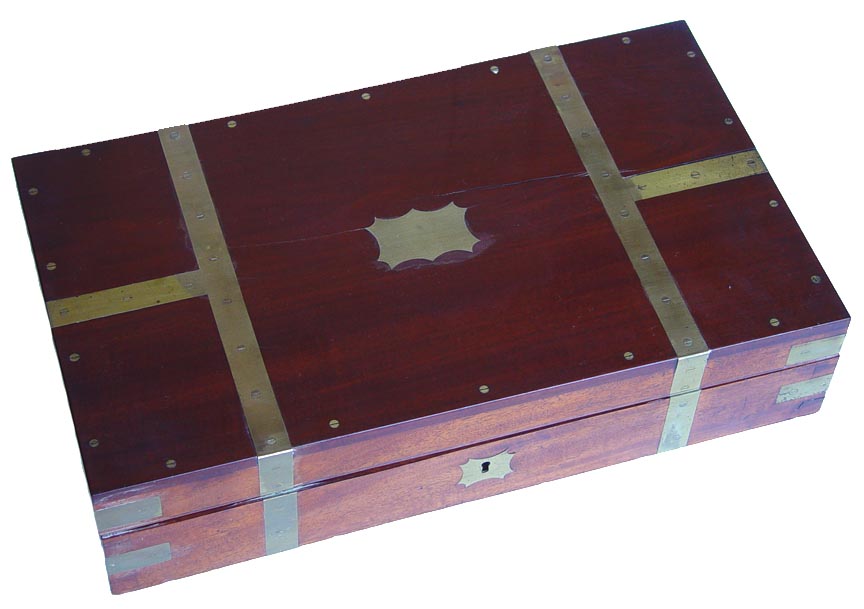
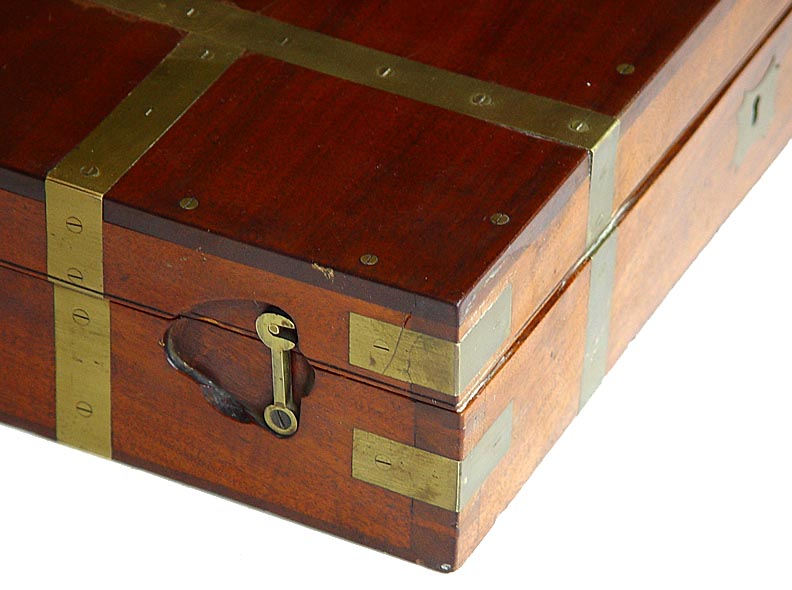
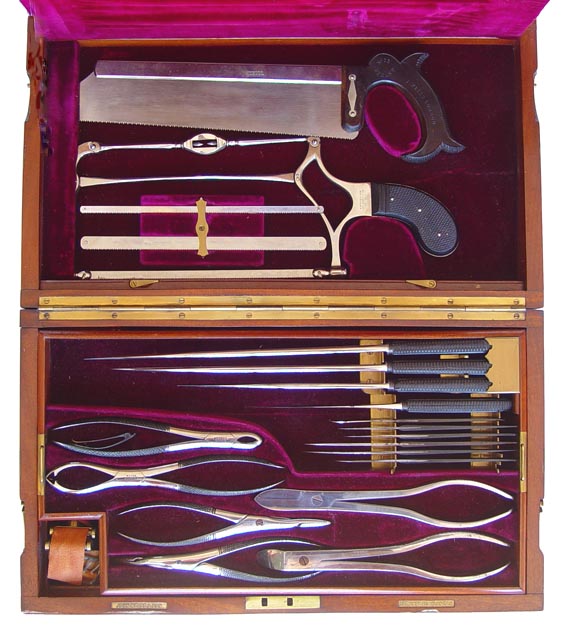
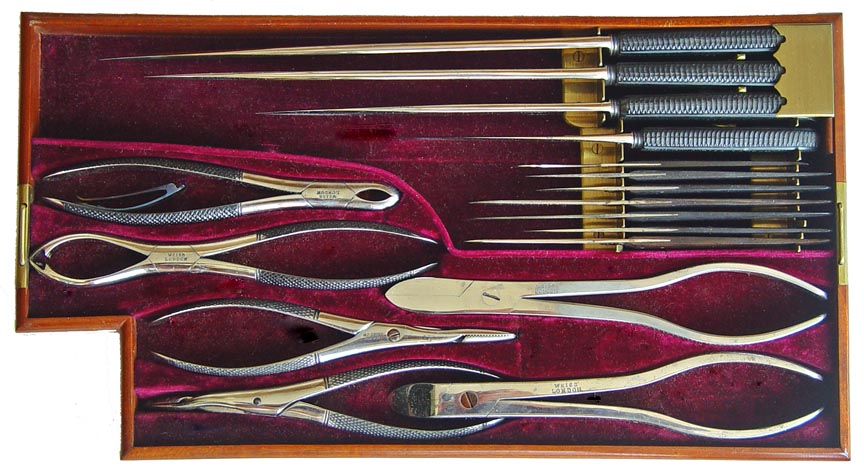
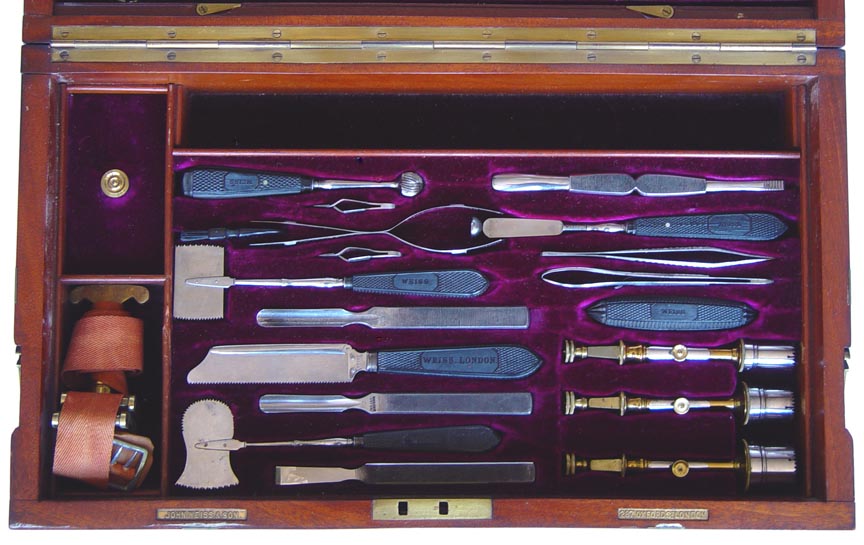
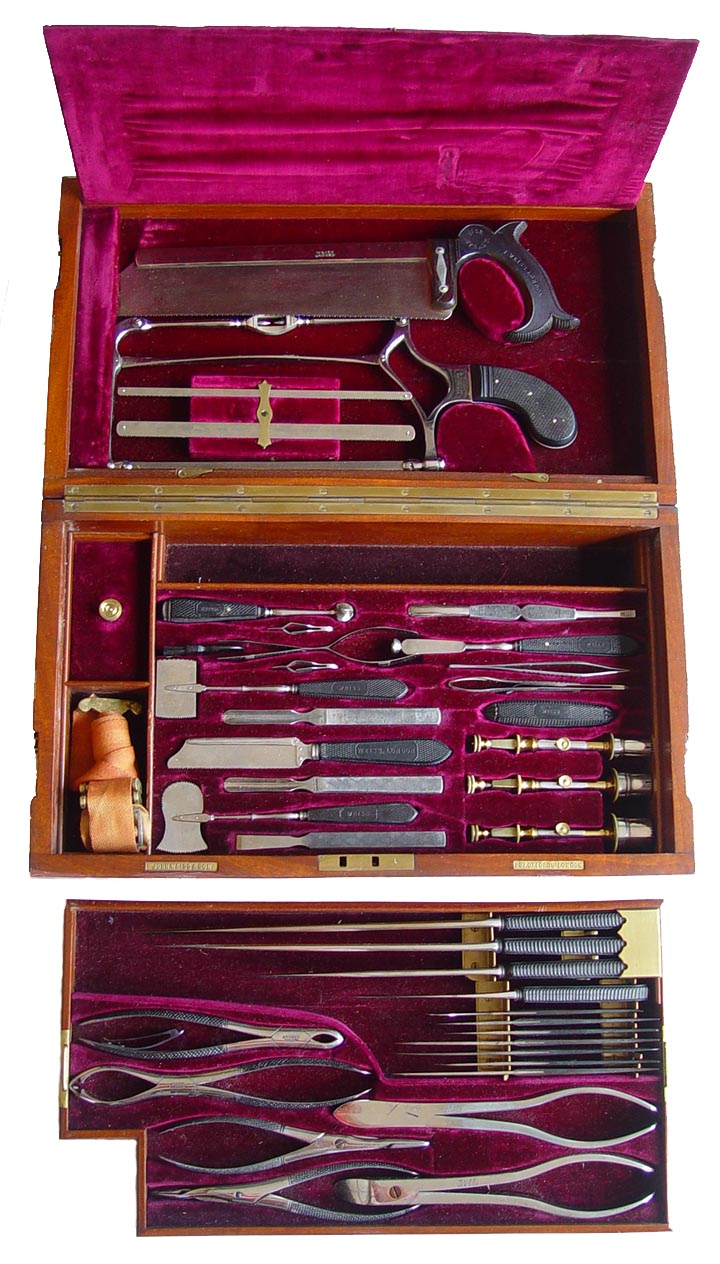
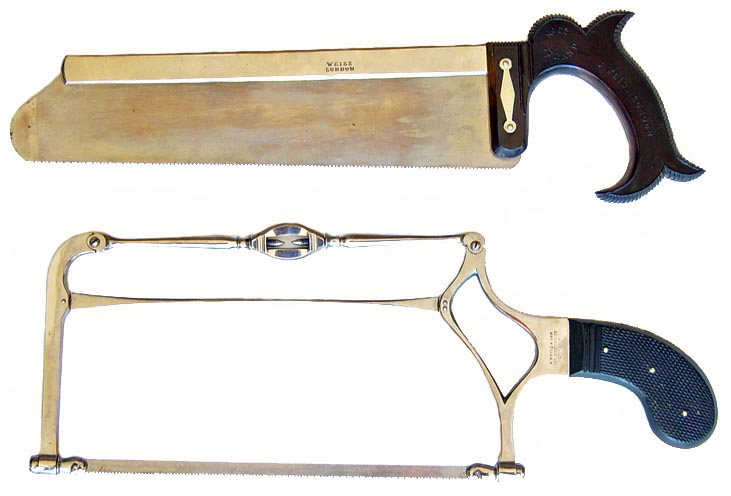
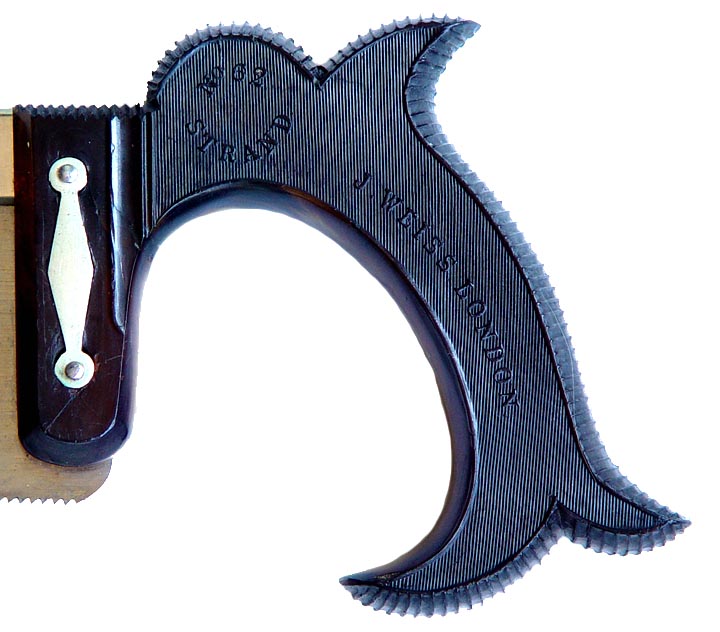
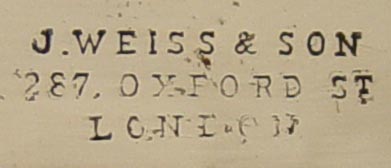
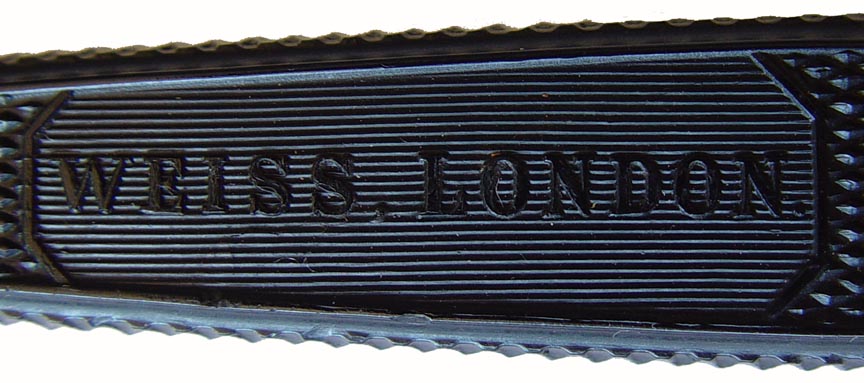
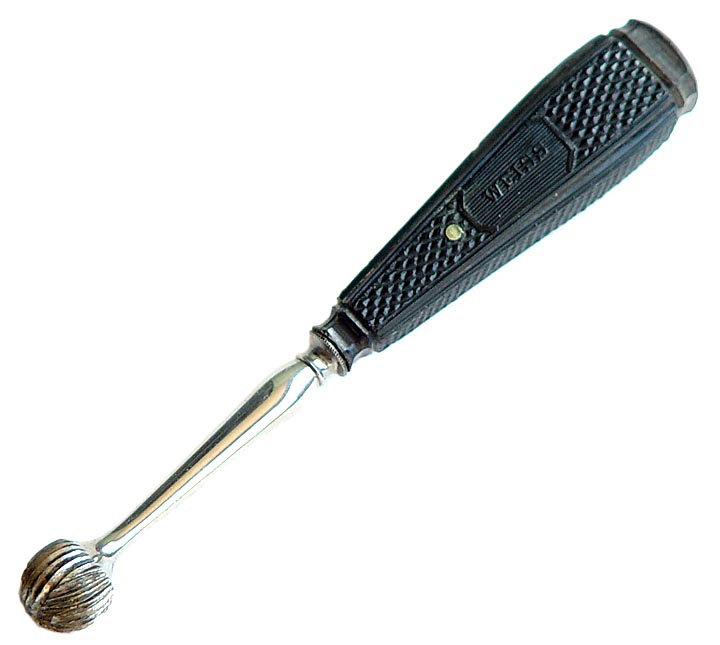
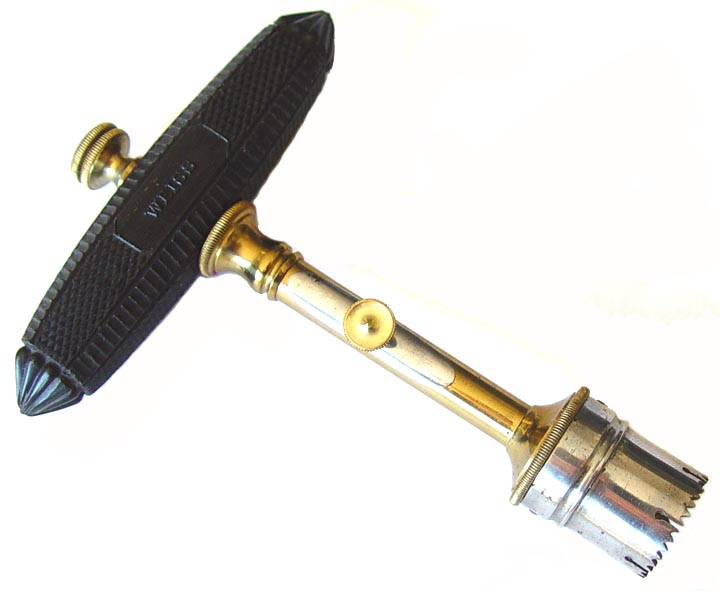
| 66. A superb c. 1860 antique surgical set by John Weiss & Son, No. 62, Strand, and No. 287, Oxford Street, arguably the best instrument maker in London at the time. Note that the Weiss name appears in relief on many of the pressed-horn handles; this feature is found on instruments illustrated in the 1863 Weiss catalogue and in Bennion, Plate I. The selection of saws, knives, trephines, chisels, bone forceps, etc., favor orthopedic and neurologic (brain) surgery. Two capital saws are present...the tenon saw was for arm and lower leg amputations, while the Dr. Butcher's saw, introduced in 1851, was designed for resectioning and hip amputation. The 1863 Weiss catalogue presents a Marshall's Osteotribe, or Rosehead, for Necrosis...and a fine example is found in the set. Also worthy of mention is the trephine's handle with delicately segmented finials. SOLD |
|
| 67. A Victorian antique microscope slide cabinet with 12 drawers. Approximately 140 antique microscopical slides are present. $2,800 |
|
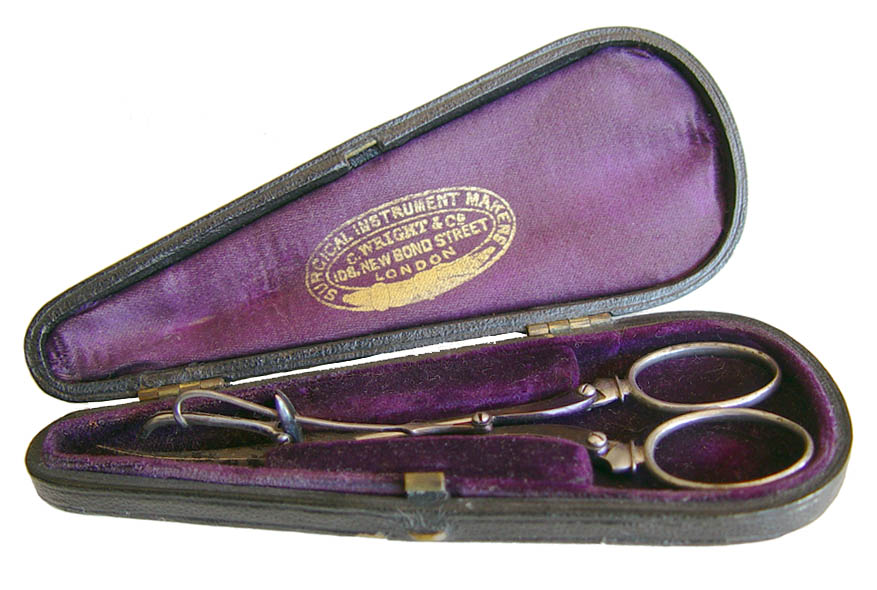
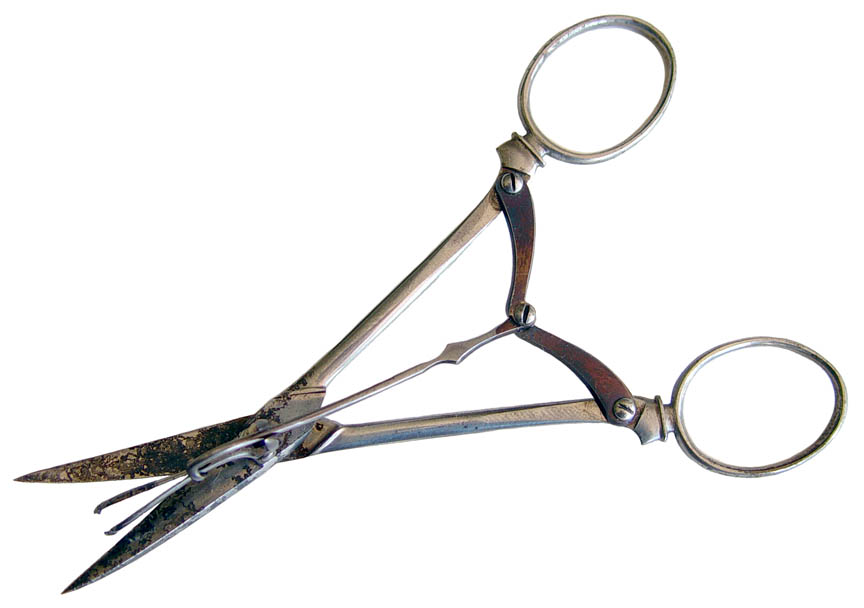
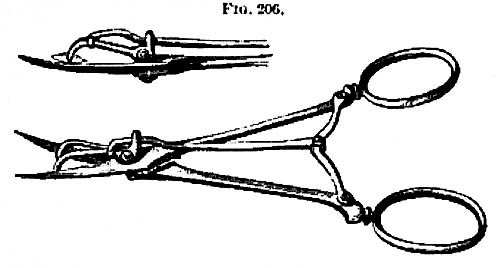
| 68. A pair of antique skin grafting scissors as invented in 1872 by Sir Thomas Bryant (1828-1914), surgeon of Guy's Hospital. Dr. Bryant illustrates and describes the use of the instrument in his book A Manual for the Practice of Surgery, 1873. These rare antique dermatological surgical scissors are stored in their original case with the logo of the surgical instrument maker C. Wright & Co., London. SOLD |
|
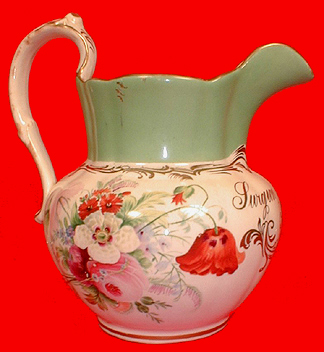
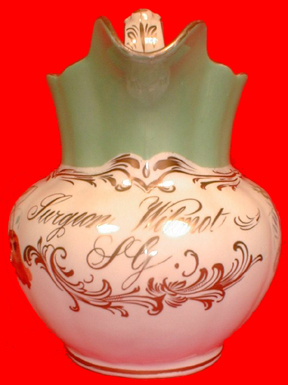
| 69. A fine c. 1840 antique Staffordshire jug decorated with two hand-painted groups of flowers and numerous gold border flourishes. The front of the pitcher is signed in a fancy gold script: Surgeon Wilmot / SG. The jug was probably a presentation piece to the the Irish surgeon Samuel Wilmot (1772-1848), who was twice President of the Royal College of Surgeons of Ireland (1815 and 1832). He resigned the position in 1848. The SG of the inscription may represent St. Stephen's Green, a Dublin park (and surrounding road) on whose west side was located Dr. Wilmot's surgery (No. 120 West) and the then and now headquarters of the RCSI (No. 123 West). The area is commonly referred to as just Stephen's Green. Such Staffordshire jugs were a popular gift in the nineteenth century, and this dealer has seen one other that was given to a veterinary surgeon. $475 |
|
| 70. A superb English antique ear trumpet made in sterling silver by the silversmith Thomas Bartlett, Birmingham, 1820. This impressive antique hearing aid features the beautifully engraved name of John Bentley. A similar antique silver ear trumpet appears in The Connoisseur, an 1811 painting by Michael William Sharp. $5,850 |
|
| 71. An antique c. 1840 Gould microscope by Cary, London. $950 |
|
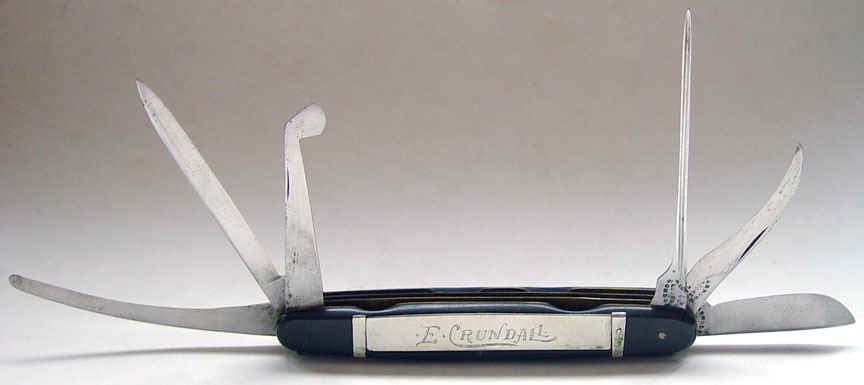
| 72. A rare c. 1880 surgeon's pocket knife containing six instruments, including a bistoury, finger knife, Syme's abcess knife, scalpel, gum lancet, and director/probe. Each instrument is marked by the maker: ARNOLD / & SONS / LONDON. Attached to one side of the grip horn slabs is a silver plate engraved with the name of the original owner: E. Crundall. $650 |
|
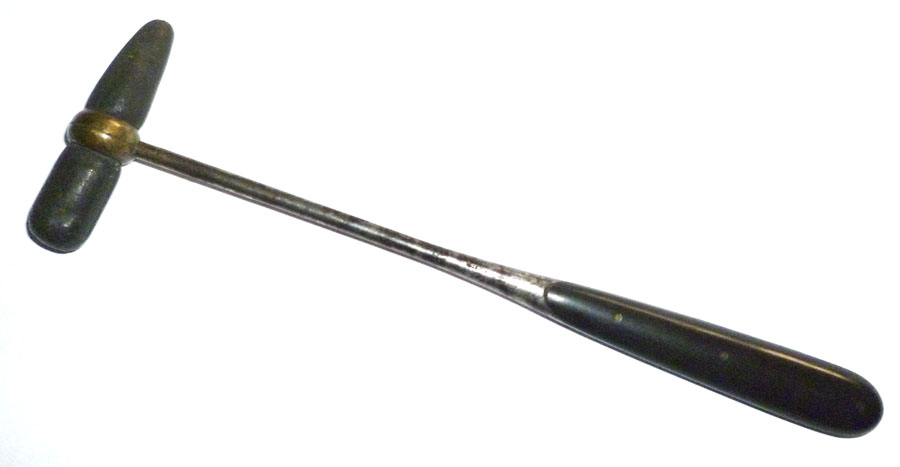
| 73. A c. 1870 antique Flint's percussor by Tiemann, New York. $275 |
|