| 130. A hand-illustrated drawing of an Ottoman Turk dental scene showing the application of a drill hand-powered by a bow. A most interesting and decorative composition. $275 |
|
| 131.
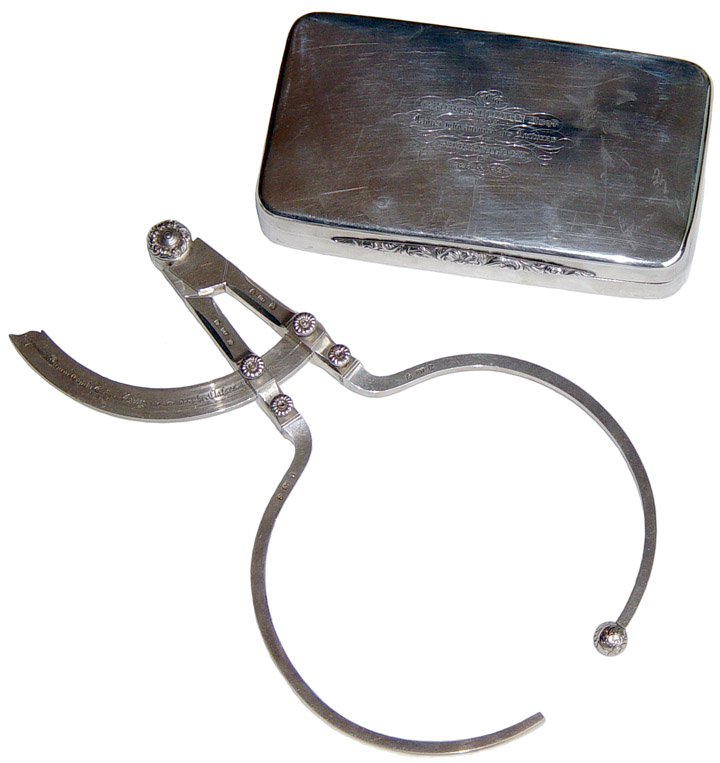
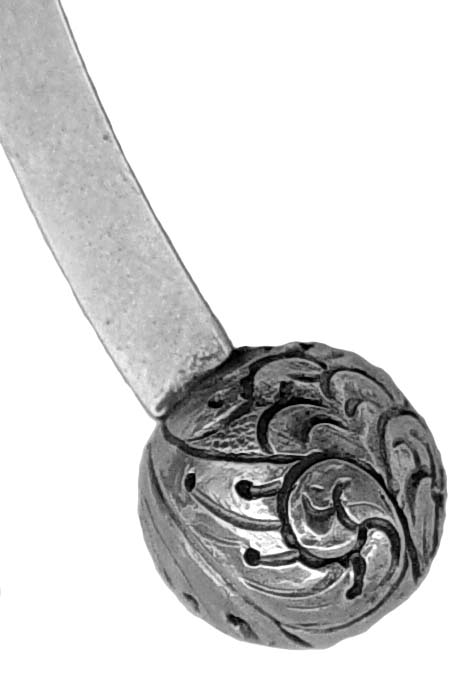
An exquisite and magnificent set of antique phrenology
calipers made by IR (James Redpath or John Robb) and hallmarked
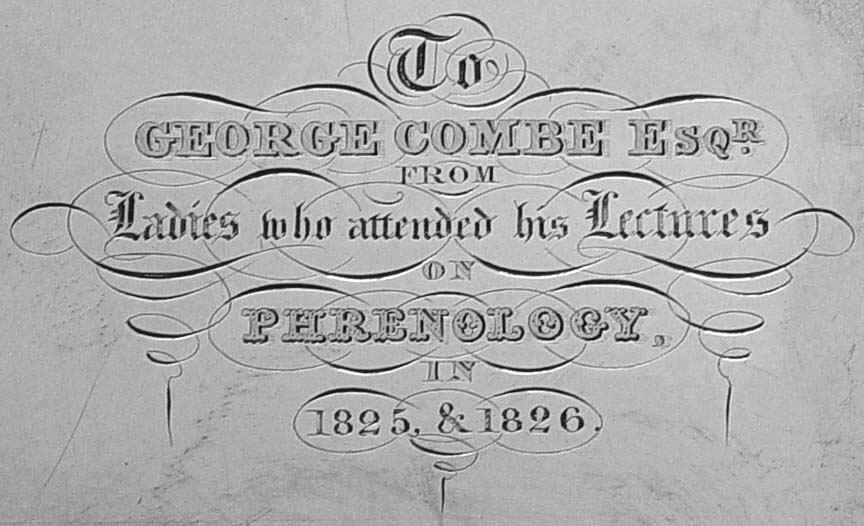
three times for Edinburgh, 1825. The case is engraved on the lid: To
/ GEORGE COMBE, Esqr. / FROM / Ladies who attended his Lectures / On /
PHRENOLOGY, / IN / 1825 & 1826. The arc is further engraved: To
George Combe Esqr. Ladies who attended his Classes of 1825 & 1826.
The instrument is assembled from four pieces. Note the decorated ball
finial on one caliper tip for placing within the ear to serve as a
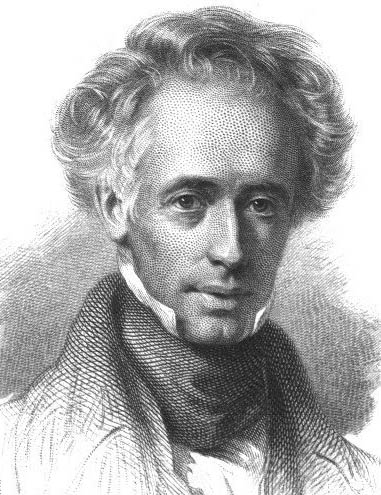
standard point of measurement. For a biography of the phrenologist George
Combe (1788-1858), please see this
link. A
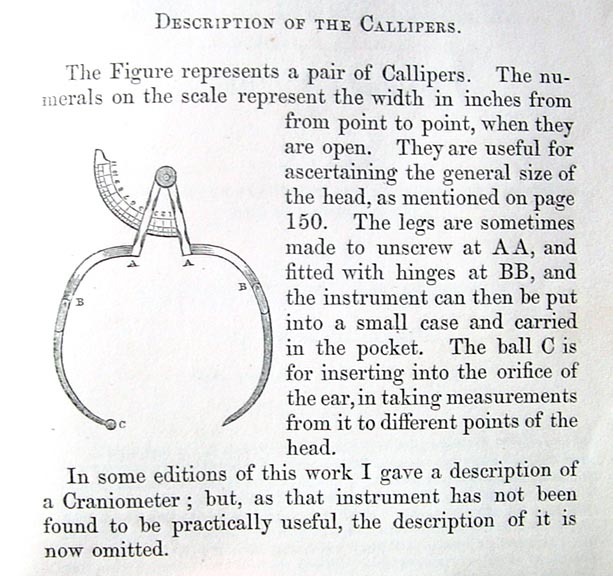
nearly identical antique craniometer is pictured in Combe's book,
Elements of Phrenology, 1824. This
may have been the maker's model. Combe remarks that such a set can be
made so that it comes-apart for fitting into a small pocket case. SOLD |
|
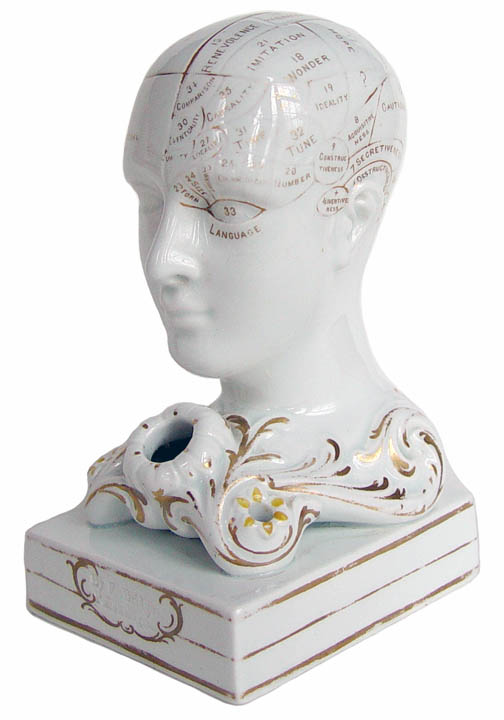
| 132. A c. 1850 antique phrenology bust inkwell impressed along the front: By F. Bridges / Phrenologist. Frederick Bridges was a Liverpudlian phrenologist of the mid-19th century. The use of gold divisions, labels, numbers and flourishes, as opposed to the more common black and blue, is an attraction. 5.25" tall. $850 |
|
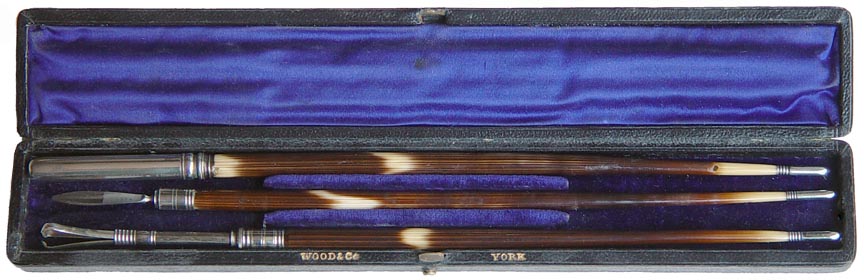
| 133. An exquisite and scarce cased-set of c. 1870 antique gynecological instruments with silver fittings and porcupine quill shafts. The instruments, known as Bennett's uterine set, are a scarifying lancet, a sponge holder, and a caustic holder. The compendium was made by Wood & Co., York. This is the very set pictured in Bennion, Pl. IV. $1,950 |
|
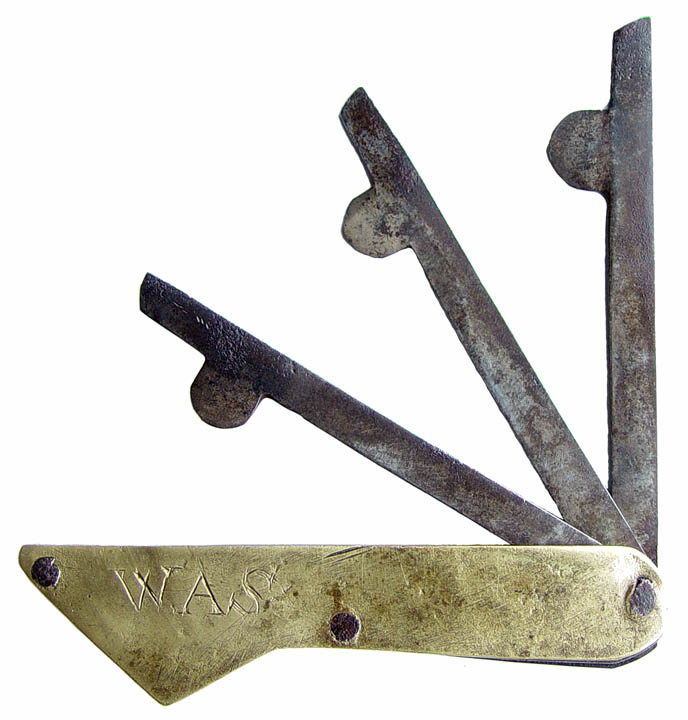
134. An 18th century antique bloodletting fleam with brass case engraved with the initials: WAS. $125 |
|
| 135. A fine sterling silver military style wristwatch by the Elgin National Watch Company. The Elgin grade 463 movement's serial number of 21092177 indicates that the watch was made in 1919. The snapback is hand-engraved: E.W. Collins M.D. / Denver Colo[rado]. Dr. Edward W. Collins (b. 1878), of Denver, was a captain in the Medical Corps, U.S. Army, during World War I. $950 | |
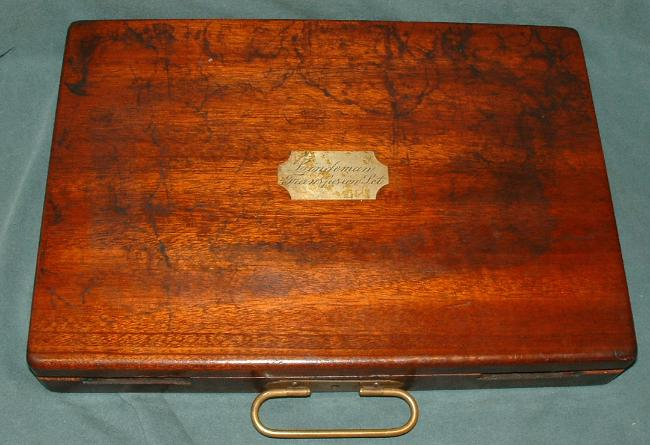
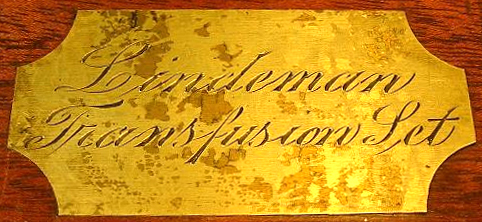
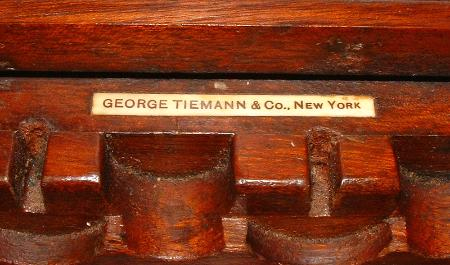
| 136. A case for antique
blood transfusion instruments made by George Tiemann, New York.
The brass lid cartouche is engraved: Lindeman / Transfusion Set.
In 1913, Edward Lindeman, of Bellevue Hospital, New York, introduced a
new needle method of blood transfusion, an advancement over the surgery
method. Lindeman's system employed multiple syringes and cannulae.
By 1915, when the four-way stopcock procedure was developed by Unger,
the more cumbersome Lindeman scheme fell-out of favor. While all
the instruments are missing...indeed, this dealer has never seen a set
for sale, the case and cartouche, in-and-of-themselves, are worthy of
interest to the student of blood transfusion history. $275 |
|
| 137. An antique esophageal coin-catcher and probang for extracting and thrusting lodged obstructions. $275
|
|
| 138. An extensive set of c. 1880 antique urological instruments by George Tiemann, New York. The brass cartouche set into the top of the mahogany case is engraved: MED. DEPT. U.S.A. $1,250 |
|
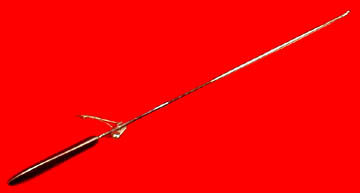
| 139. A c. 1880 gynecological mechanical curette with ebony handle. A lever just above the handle moves to a right angle a small tip cup. Unsigned, but by Katsch, Munich. $65 |
|