Alex Peck Antique Scientifica
Sale Catalogue
Page 22
Below is a listing of a few medical and scientific antiques that are currently for sale. Please feel free to send an e-mail or to call (217) 348-1009 for additional details and to place an order.
Click on the thumbnails for enlargements and additional views.
All pictures and text on this site are copyrighted ©1982-2008 Alex Peck. All rights reserved.
SALE CATALOGUE PAGE 22
1. 2. 3. 4. 5. 6. 7. 8. 9. 10. 11. 12. 13. 14. 15. 16. 17. 18. 19. 20. 21. 22. 23. 24. 25. 26. 27. 28. 29. 30.
|
168. A c. 1650 iron bow frame capital amputation saw with smooth wood grip. The blade is quite wide to compensate for the then current state of metallurgy. This antique surgical saw is over twenty inches long. |
|
|
169. An attractive and
innovative c. 1860 brass monocular microscope signed: J. Cail, /
Grey Street, / Newcastle / on Tyne. John Cail, a maker of
various optical instruments, was located at this address from 1855 to
1865. (See Clifton, Directory of British Scientific Instrument
Makers 1550-1851, p. 47.)
This is a very fine Civil War era brass antique microscope, and it has a well thought-out design. Note, for example, the column pillar inset which conceals the mirror support when in the vertical position. Numerous original accessories, among them four objectives and a mechanical stage, are included. John Cail instruments are of high quality and quite scarce. None are found in the Royal Microscopical Society or Billings collections. |
|
|
170. An unusual and specialized c. 1860 orthopedic surgery set by Mathieu, Paris. The instruments include a trephine, a chain saw, two chisels, a mallet, a metacarpal saw, an elevator, two bone forceps, and three bone scrapers. Seven of the instruments have ebony handles. A chain carrier and a retractor are missing. The mahogany case has an inset brass handle and is leather lined in the French manner. |
|
|
171. A c. 1880 antique tongue depressor with ring for hanging from a chatelaine. |
|
|
172. A World War I artillery part-shell casing that is professionally engraved: This shell was picked up on / MONT DURY / by Nursing Sister / OLIVE GOAD / in the Spring of 1919 / NEAR THE PLACE WHERE HAROLD FELL / 2nd SEPT 1918. Mont Dury, France, was the site of an August-September 1918 engagement between British and Canadian forces and the German army. For more information about this battle in which the Canadian Corps suffered 5,600 casualties, click here. A website dedicated to the history of the Canadian Nursing Sisters can be found here. The brass 4.5 howitzer shell is manufacture dated 1915 and the firing charge is dated 9/17. There are numerous other stampings, including CF (Charge loaded with cordite / Full charge) above the military property broad-arrow mark and a circled letter A followed by a dot, which indicates that the shell casing was reloaded twice. This is a poignant medical-related memorial souvenir of WWI. |
|
| 173. A c. 1850 antique phrenology bust inkwell embossed along the front: By F. Bridges / Phrenologist. 14cm tall. |
|
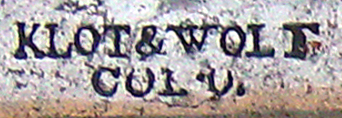
| 174. A pair of c. 1850s antique dental extracting forceps by Klott & Wolf, Columbus, Ohio. Edmonson lists both makers but not in partnership. An alternate spelling of Klott (Klot) is noted in the actual markings of the instruments. See Edmonson, p. 250. | |
|
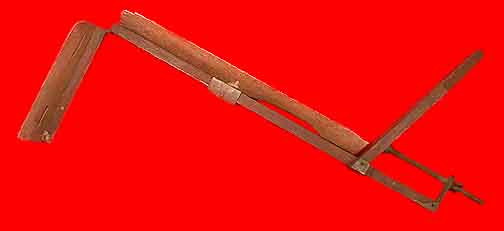
175. An articulated full-leg double incline splint made of wood and with fixtures of brass. The foot-rest is adjustable and the slits in the boards were used for attaching cloth tape which would hold the leg and foot tight. Pressed into the wood of the footrest is: L. ROES / PATENT / MAY 6 1844. A brass adjusting rod at the joint is missing. This is the earliest American-made splint known to this dealer. Exceedingly scarce. |
|
SALE CATALOGUE PAGE 22
1. 2. 3. 4. 5. 6. 7. 8. 9. 10. 11. 12. 13. 14. 15. 16. 17. 18. 19. 20. 21. 22. 23. 24. 25. 26. 27. 28. 29. 30.
Archives Articles Home Page Reference Books