Alex Peck Antique Scientifica 

Sale Catalogue

Page 30

Below is a listing of a few medical and scientific antiques that are currently for sale.  Please feel free to send an e-mail or  to call (217) 348-1009 for additional details and to place an order.  Click on the thumbnails for enlargements and additional views.

All pictures and text are copyrighted 1982-2008 Alex Peck.  All rights reserved.

a.peck@mchsi.com


SALE CATALOGUE PAGE 30

1.   2.   3.   4.   5.   6.   7.    8.   9.   10.   11.   12.   13.   14.   15.   16.   17.   18.   19.   20.   21.   22.   23.   24.   25.   26.   27.   28.   29.   30.


233.  A fine example of a solid gold Struthers Anatomy Prize medal, Aberdeen University, in its original fitted-case.  Sir John Struthers, MD, LLD, FRCSE (1823-1899), who held the chair of anatomy at Aberdeen from 1863 to 1889, proposed, in 1889, an annual honor for best dissection by an undergraduate. The first winner was announced in 1893.  Dr. Robert W. Reid (1851-1939) succeeded Struthers to the anatomy chair, and he awarded this particular prize medal to W. Marshall Phillip, M.C.B.M., in 1896.  Dr. William Marshall Phillip (1872-1932) earned distinction as an efficient Medical Officer of Health of Colombo, Ceylon, for which he received the C.B.E. from King George V.  The Struthers medal was made to a high standard by the jeweler Millar of Union Street, Aberdeen, and it measures 6cm by 5.3cm.  For more information about and the Struthers Anatomy Prize and the remarkable career of Dr. Struthers, please see this link.  Some biographical comments on  Dr. Reid, who had a special interest in anthropology, are found at this link.  Dr. Phillip's obituary is at this link.  

medal, Struthers Anatomy Prize, Aberdeen, 1896, in case.jpg (33046 bytes)

medal, Struthers Anatomy Prize, Aberdeen, 1896, award side.jpg (36442 bytes)

medal, Struthers Anatomy Prize, Aberdeen, 1896, winner side.jpg (28825 bytes)


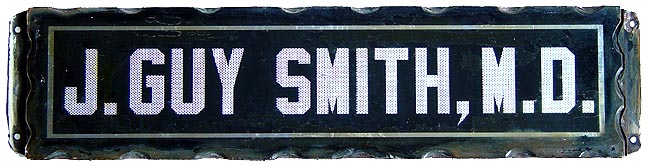
234.  The c. 1920 doctor's office sign of J. Guy Smith, M.D., who is believed to have practiced in the Canfield, Ohio, area.  The frame is made of metal and the lettering is protected by a thick glass insert with scalloped border.

sign, doctor's, J. Guy Smith.jpg (51790 bytes)

 
 235.  An unusual c. 1870 medical dry cupping set that is finely cased with trade label and  fire-gilt brass lock  marked by Jenner & Knewstub, of 33 St. James’s Street, a rather high-end London company active in the 1860s-80s.  There is a double-E monogram on the leather-covered lid, and the name COOKIE. is gold-embossed on the interior lid velvet.  The hinges and corner braces are also fire-gilt.  The visual impact makes a most elegant presentation, and the set was clearly intended for use by an upper class doctor or household.  The cups are French-fitted and not loose in their individual compartments.  They also are  bigger than those typically found...the largest being 17 cm long.  The greater  the  volume of the cups, the greater the vacuum when heated.  The brass lamp retains its original snuffer.  This antique counter-irritation set was meant for dry cupping only and never contained a scarificator.  


bloodletting, cupping set, Cookie, exterior.jpg (51260 bytes)

bloodletting, cupping set, Cookie, open full.jpg (72035 bytes)

bloodletting, cupping set, Cookie, open down.jpg (74703 bytes)

bloodletting, cupping set, Cookie, lamp and cups.jpg (34364 bytes)

bloodletting, cupping set, Cookie, lamp and cups, 2.jpg (55057 bytes)

bloodletting, cupping set, Cookie, lamp.jpg (47485 bytes)


236.   A c. 1860 antique amputation saw by Luer, Paris.  The handle of this fine bow saw is ebony.

saw, amputation, bow, Luer.jpg (40742 bytes)

237.  An antique obstetrical hook and crotchet marked  by S. Maw, a London surgical instrument maker.  The center handgrips are ebony.


ob, crotchet and hook, S.Maw.jpg (31163 bytes)


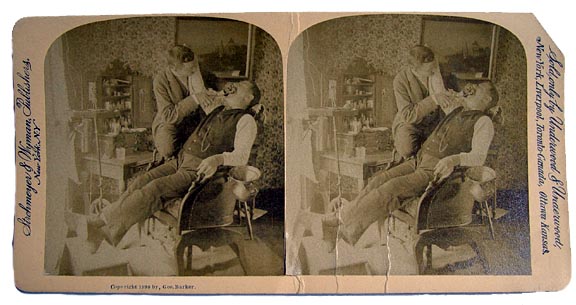
238.   A stereoview of a spoof dental extraction in a late 19th century dental office.  Note the pedal dental engine (drill) to the left and the swan-necked arms on the purpose-built dental chair.  The image is copyrighted 1890 and is from New York.  Penciled on the back is the caption  Oh, what a tooth.


photo, stereoview, dental scene, NY, 1890.jpg (69598 bytes)


239.  A wool blanket embroidered:  M.D. / U.S. Army. / 1942.  A fine WW II U.S. Army Medical Department artifact.


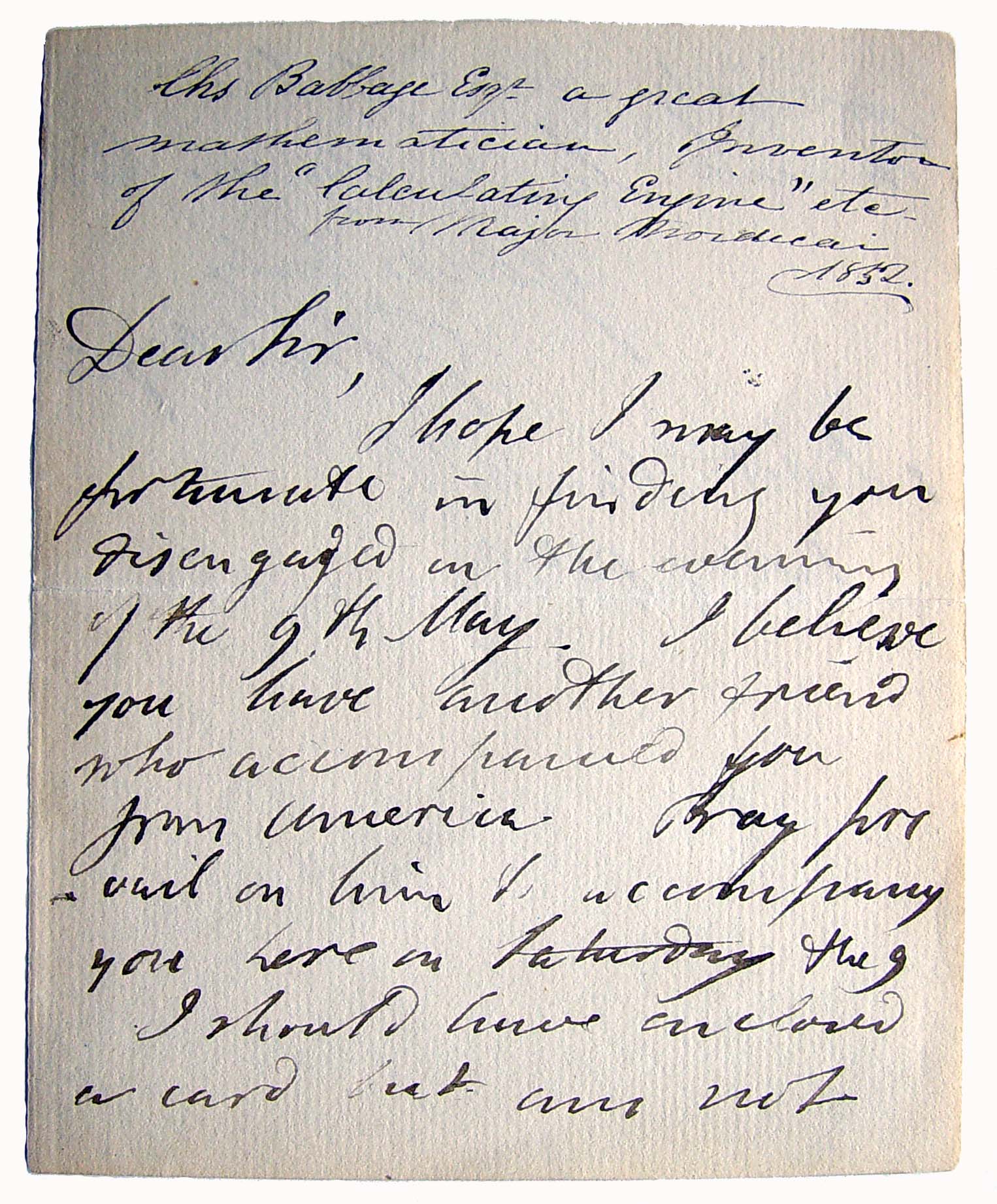
240.  An autograph letter from Charles Babbage (1791-1871), British political economist,  mathematician, and the inventor of the first computing machines, which are the ancestors of the modern computer.  The letter is dated 1 May 1840, and it is an invitation to attend one of Babbage's well-known salons.  The invitee is Major Alfred Mordecai (1804-1887), who, at the time, was the U.S. Army's foremost ordnance expert and in Europe to examine arsenals and cannon foundries.  Later, in 1852 and in Mordecai's hand, a notation is made on Charles Babbage's inventing of the Calculating Engine. doc, ALS, Charles Babbage Alfred Mordecai, 1840.jpg (415389 bytes)

doc, ALS, Charles Babbage Alfred Mordecai, 1840, reverse.jpg (72731 bytes)

_____________________________________________________________

SALE CATALOGUE PAGE 30

1.   2.   3.   4.   5.   6.   7.    8.   9.   10.   11.   12.   13.   14.   15.   16.   17.   18.   19.   20.   21.   22.   23.   24.   25.   26.   27.   28.   29.   30.

a.peck@mchsi.com

Archives       Articles    Home Page   Reference Books

Sale Catalogue    Wants